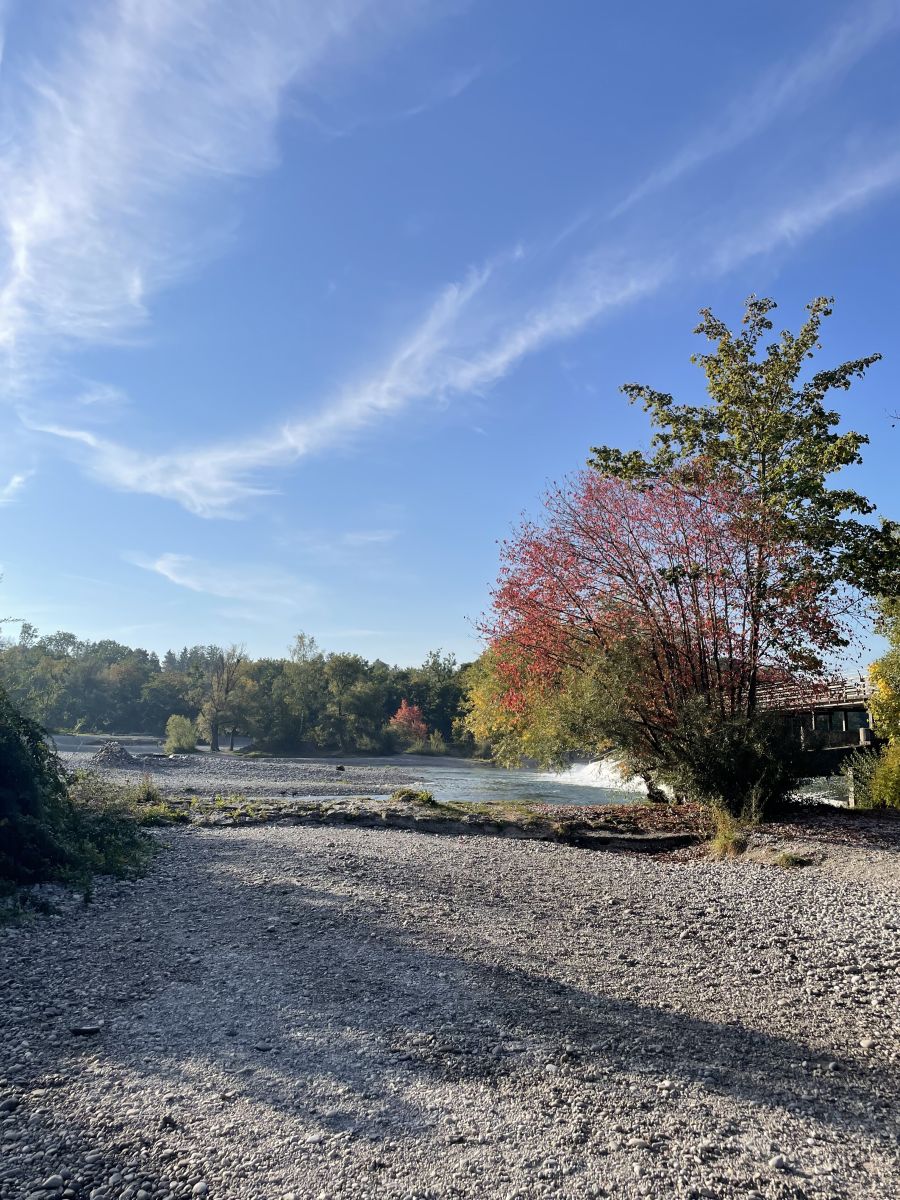
Swimming in the river XVI - made of moods
Why all this talk about the weather? Because it acts as a stand-in for our moods and serves to justify them. Often we don’t know why we’ve had a bad dream, or which foot we got out of bed with. Often enough, we don’t want to know either. In any case, it’s the weather’s fault. If we look more closely, however, the relationship between cause and effect becomes more vague.
Alain de Botton was already an established philosopher in his early twenties, an admirer of Proust and a connoisseur of the human psyche, as reflected in Proust’s *In Search of Lost Time* and de Botton’s book on the subject. It seems to me that we are all on a quest. But what, exactly, are we searching for?
In the language of the High Middle Ages, it would be a ‘queste’; as knights and minstrels, we would dedicate our hearts to the king and to our beloved High Lady, in whose worship we hope to perfect ourselves both worldly and spiritually.
My current quest is my swim in the Isar. Having passed the age of 50, Alain de Botton took psychology seriously and became a psychotherapist. In a multitude of lectures, available to watch online, he speaks of the depths of the human psyche in polished sentences, with an unmistakably elegant Oxford accent and un-British emotionality. About the volatility of our moods. We are made of moods, we are literally water, we are fog. I can’t help but smile when I hear this and think of my daily penitent walks to the river.
Why is it that on some days, when I plunge into the water, a cloud lifts and the underlying joy of existence is simply… there? Why can other moods be so oppressive that the water only temporarily dispels them? Why, on a gloomy day, can that green-grey melancholy be so enchanting? Why, on so many days, is everything fine before, after and even whilst I step into the cold water? I don’t know.
This year’s Nobel Prize in Medicine has been awarded to three neuroscientists. Of course, I haven’t understood what they’ve been recognised for. Only that it involves, amongst other things, light impulses in algae. These provide insights into signalling pathways in the human nervous system. Fascinating. If an alga reacts to light, how could I not react to light? I haven’t yet worked out what sort of creature I am. Perhaps it has something to do with algae: a light-sensitive amphibian.
Before I forget: this morning the sun finally came out, a little later than usual. The water was lovely. Quite cold. But soft. I leaned in from the inside and floated on the membrane.